
NYC New Development
02/9/22
So, you are considering buying an apartment in one of the new residential buildings that will soon be gracing our skyline.
Next, you will tour a model apartment with exquisite staging by a famous interior designer, and then experience an actual “hardhat tour” of the building site in progress (where you can make certain that the unit of your dreams doesn’t face a brick wall).
Now that you’re head over heels and ready to swing the bat, here are 7 little-known curveballs to look out for:
1. SQUARE FOOTAGE – The developer is allowed to deviate up to 5% from the promised space in the offering plan, regardless of how or why it was reduced. (In a 1,500 square foot apartment, that’s a 9×8 home office space…GONE.) Luckily, today we are doing far fewer sales from floorplans, and more sales once the building is framed out. So I take my own measurements – and do not rely on the provided floorplans.

There is also no set threshold for cubic foot deviation. Meaning there is nothing obligating the developer to deliver the CEILING HEIGHTS promised or preventing them from installing ductwork or soffits that will reduce the usable space in the home. Even if you were sold 11’ ceilings but receive 8’ ceilings instead, this is not necessarily an “out” from the contract.

3. AMENITIES promised (bowling alley, hammam, doggy wash, etc.) might not actually get delivered, despite being listed in the offering plan. As often occurs, if you purchase your apartment prior to the offering plan being legally declared effective, the developer has the right to make alterations and exclusions as they see fit.

Also, these common spaces are typically the last to be completed. So even once you close and move into your brand new apartment, prepare to live adjacent to a pseudo-construction zone for the next year +.


The offering plan must be declared effective before closings can begin. This requires 15% of the units to be in contract.
A separate tax block and lot must be assigned to each individual unit, so legal ownership can be transferred via deed.
Prior to closing, a temporary or permanent certificate of occupancy must be obtained for the project.
These boxes can only be checked with the involvement of government entities.
In larger buildings that have not sold out, you could still be competing with original sponsor units when you go to sell 5 years later. In theory, you would have gotten a much better deal on your unit having purchased pre-construction. This may or may not be the case depending on the market and how motivated/negotiable the sponsor is to sell the remaining units.
Add Your Heading Text Here

Now that you’ve negotiated your contract and patiently waited for your new home to be ready, prior to closing you will attend a PUNCHLIST WALKTHROUGH of the apartment accompanied by a representative of the sponsor, with a roll of blue painter’s tape in hand to mark any defects that the sponsor will be responsible to fix within a “reasonable period” after closing.
Generally, that time is not specified in the contract, which can become a point of frustration once you are already closed. However, there are a host of tweaks that can be negotiated into a contract to protect you from this and other possible mayhem – and that’s where our team comes in, along with a seasoned real estate attorney who also specializes in new development.
Although buying in a new development may seem daunting, some of the most spectacular buildings in Manhattan are either brand new or new conversions of historical buildings, with services and amenities that are unmatched, and buying early is the way to get the best units and (usually) the best prices. So remember that where there is risk there is also great reward, and we are here to guide you.
And if a picture is worth a thousand words…

555 West End Avenue, SOLARIUM

1 Prospect Park West, Unit PHA

515 West 18th Street, Unit PH2203
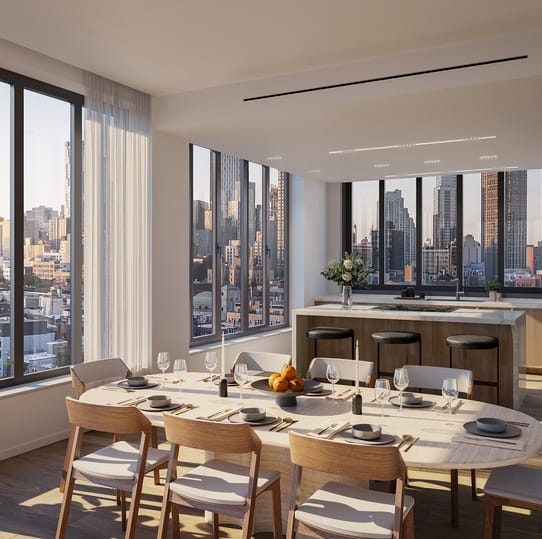
58 St Marks Place, Unit 1105

10 Riverside Boulevard, Unit 30C